It happened every weekend, especially on Saturdays. Emefa would visit my parents’ house, and together we would walk to Abena’s place, somewhere in the northern part of town. The journey was long, but always interesting with Emefa. We talked about anything we found amusing, especially gossip, and before we realized it, we had arrived. Our favourite topics were fashion trends and how out of place some ladies in our town looked. Rumors kept us entertained: a girl was pregnant, someone accused another of being a witch, whispers about a pastor involved with a church member’s wife, or tales of a successful trader suspected of using juju. There was always something to discuss. If there wasn’t, we invented our own tales. Once we reached Abena’s, we shared the latest news. Abena would contribute her own pieces of gossip, and our eager ears were always ready.
On this particular day, Abena called and asked us to meet her at Sister Serwaa’s salon, where she was having her nails done.
“Ei, that girl. I know her. I am sure she is painting her nails with one of those bright colors,” Emefa said when I told her about our change of plans. “You are already fair, beautiful, with all the curves in the world. All the men chase you, just like ants gathering around spilt sugar. Why not leave some room for us, we the somehow chocolate ones?” She complained as though Abena was with us and could hear everything.
Emefa always admired and envied Abena, our fashionista friend. Abena always knew which dress to wear and the perfect colour combination for every occasion and every skin tone. If not for her, I would never have learned that different face shapes had specific hairstyles that suited them, or that certain lens shapes matched particular faces. Abena alone knew which body lotions and pomades kept her skin glowing. Emefa wished for her flawless complexion and never hid her friendly but zealous envy.
Abena had a treasure chest of accessories. Her mother ran a small boutique in the city, which explained Abena’s endless supply. Her six-inch platform shoes were a world apart from the second-hand two or three-inch shoes we bought at the roadside. I admired the effort she put into looking beautiful, though I thought it was unnecessary. I was never envious of her skin, accessories, or taste in fashion. Emefa was the one who needed deliverance from her envy. She became a kind of voyeur, begging, borrowing, or even stealing to match Abena’s elegance, but her attempts rarely succeeded. Abena never realized she was in competition. For her, fashion and beauty were natural talents, and she felt no need to compare herself with anyone. Yet, economics teaches us that human wants are unlimited and satisfaction is always elusive.
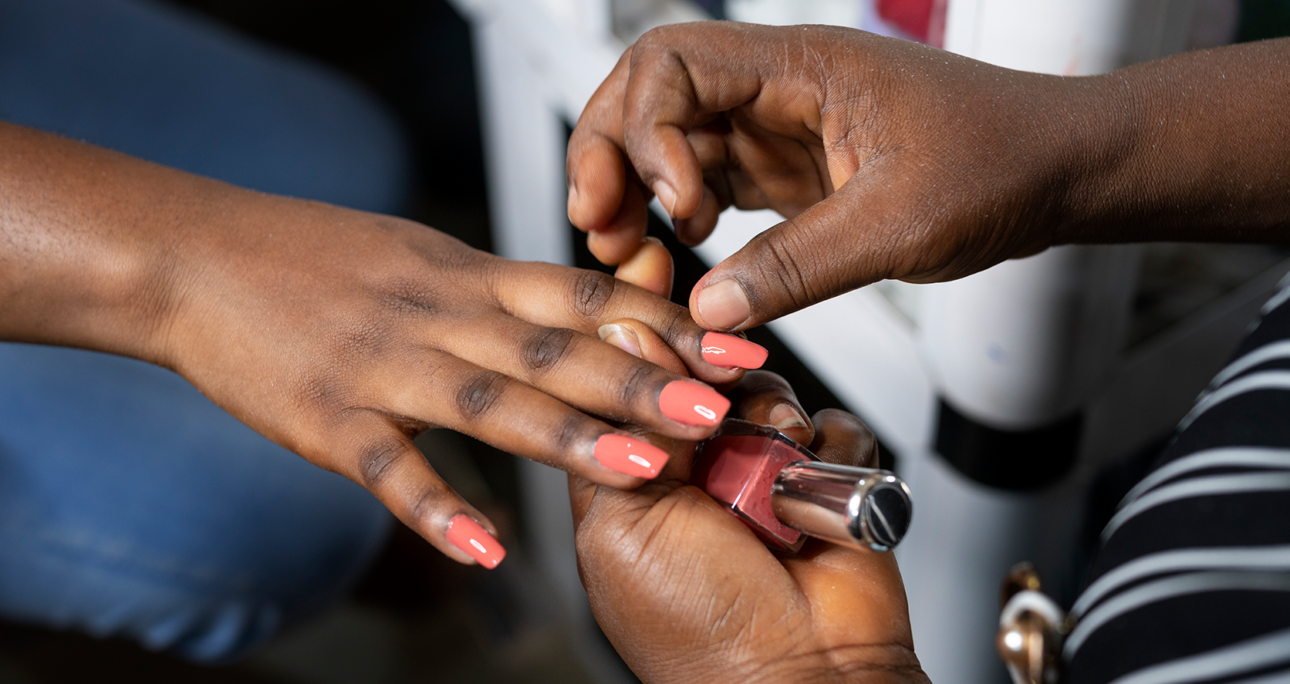
We found Abena at the salon, sitting on a plastic chair, her palm stretched forward as though about to receive a ring from Sister Serwaa, who perched on a lower stool. Sister Serwaa was painting her nails pink, a deep, striking shade.
“I told you she would pick a bright color!” Emefa declared, loud enough for Abena to hear. Abena’s lips curled in a half-smile, as if to say she was tired of hearing silly comments.
“Sister Serwaa, how are you?” I asked, grabbing a chair. Emefa pulled up one as well. We watched quietly, appreciating the skill with which Sister Serwaa painted Abena’s nails. She paused after finishing one nail and replied, “I am fine, as you can see,” then returned to her work. “I am just in a hurry to get home and welcome my in-laws; my husband called to say they have arrived from the village,” she said proudly.
“Please take your time, Sister Serwaa. Just because you are in a hurry doesn’t mean you should rush. I plan to keep these nails for a month,” Abena cautioned.
“Don’t mind her,” Emefa said. “Even if she keeps the nails for only a week, her boyfriends will pay for a whole new set.” That wasn’t entirely true.
“Ei, who is she serving, me or you?” Abena teased.
“Oh, let me think.” They bantered, pretending to fight but always joking. I kept one eye on Sister Serwaa’s work, the other ear tuned to their playful argument. Eventually, the chatter waned, leaving a short silence. Then Sister Serwaa brought up a new topic.
“Do you know that Abedi is engaged to the surgeon from the town next to ours?”
“Which Abedi — is it the MP’s son who plays football abroad?” I asked.
“Who else could it be?”
“Really?” Sister Serwaa sounded surprised. We all leaned forward, hungry for more gossip.
“Yes,” the message bearer confirmed.
“This world isn’t fair,” Sister Serwaa lamented.
“As if you know,” Abena agreed. “The rich marry the rich, and the poor . . . well.”
“Some of them should come for us,” Emefa joked, as if making a plea.
“The poor ones,” echoed Sister Serwaa, who, though married herself, identified with our struggles more than we expected.
“So if one of those footballers asked for your hand, would you accept?” I asked, feeling it was time to add my voice. I was wary of being misinterpreted as condescending, a label attached to my quiet nature in school. Was there anything wrong with not wanting to talk about telenovelas or reality shows on TV? My friends thought it strange that I disliked telenovelas, but they were convinced every girl should love them. I found them formulaic and tiresome, a single storyline repeated endlessly. Why laugh at the same joke twice?
“If it was you, you wouldn’t accept, right?” one of them prodded.
“If I loved him, why wouldn’t I?” I replied. They all burst into laughter.
“What is funny about what I just said?” I demanded. After their laughter faded, one of them tried to answer.
“So, a millionaire comes to town searching for a bride. He singles you out, wanting you to be the mother of his children. You would say no?”
“Think about the pride that comes with it,” Abena said. “I am serious about finding a man like that.”
“I am also trying my best,” Emefa added. “I pray about it. Why do you think I go with my mother to the prayer camp almost every night?”
“All the makeup, the hair, the social gatherings they are not for nothing,” Abena continued. “I know I will meet a wealthy man sooner or later. My work will not be in vain.”
“It is a woman’s job to look beautiful and presentable. For men, looks don’t matter. Money is the only thing that counts,” Sister Serwaa declared, letting go of Abena’s hand and flicking her fingers upward as she spoke. “Yesterday, the nurse who lives across the street, the one married to the bank manager, came in to braid her hair.”
“I hope you charged a lot,” Emefa said.
“What kind of hair, twist or three-three?” Abena asked.
“She braided big twists. Can you believe she bought five packs of Obaa Sima?”
“Ei! Five? Wasn’t that heavy?” Emefa gasped.
“That is her only burden I tell you. Hair burdens.” We laughed. I thought about how much women put themselves through with extensions, nails, and hair.
“The nurse has a husband who pays for everything,” Emefa commented. “We buy two packs ourselves, maybe three if our heads are too big.”
“Speaking of her husband, he dropped her off and picked her up after I finished,” Sister Serwaa revealed.
“Seriously?” Abena sighed dreamily, forgetting her nails were wet as she placed her hand on her chest. “That is so romantic.”
“He paid three times what I usually charge,” Sister Serwaa said.
“Then you were lucky yesterday,” I said.
“I tell you.”
“How I wish I were her,” Emefa said, almost pitying herself. “She is so beautiful now that she’s married the bank manager. Her skin is smooth, lighter, she’s put on more weight.”
“He bought her a car,” Sister Serwaa added.
“Are you serious?” Abena sounded jealous.
“Very. He built her a big shop right in front of their house. I’m surprised none of you noticed.”
“I thought she was a nurse. Why a shop?” I asked.
“She sits there, just supervising the shop attendant to make sure nothing is stolen,” Sister Serwaa answered.
“So she works in a shop?” I asked again.
“Yes. If your husband wants you to stay home and take care of the house, what more could you ask for?”
“He even builds you a shop and buys you a car,” Emefa prayed. “That is exactly what I am asking for,” she lifted her palm upward. “God, please answer my prayers.”
“Don’t worry, many more will come your way. Just be smart about your choice,” Sister Serwaa advised. I did not appreciate the advice.
“What is she doing in a shop, what about her nursing degree?” I asked, clearly irritated.
“She went to training college, not university. She has a diploma,” Sister Serwaa corrected.
“It doesn’t matter whether it’s a degree or diploma; she’s a nurse. That’s what matters,” I pressed on. “Nursing is about serving the community and country. She can’t just sit in a shop with a shop assistant doing nothing.”
“That is none of your business,” Abena snapped.
“What would pregnant women do if all midwives were married to rich men who wanted them home all day?” I hoped for an answer.
“That will never happen,” Emefa said. “Let pregnant women worry about themselves.” For a moment, silence fell. I couldn’t tell whose thoughts were naive. But I could sense something was lurking in all our minds. My friends seemed worried only about marriage and material things, not about their calling or ambition. They only saw themselves as flowers waiting to be picked, unsure who would do the picking.
Emefa was a pupil teacher at the community school, and quickly became well known after she started teaching. She once gave Abena and me cookies and other gifts she received from her pupils’ parents. She claimed the gifts surpassed even what the headmistress and other teachers got, and people started to notice her. The pupils loved her teaching style, and truancy in her class all but disappeared. Their grades improved, and Emefa started enjoying teaching, even though she began just to help her younger brother get through school and support her widowed mother. Luckily, an uncle returned from France and promised to pay for her teacher training. She had bought the forms, and we were confident she would get in. I was happy for her, though she was still praying for a rich husband who would stifle her gifts with money. How many lives could she change as a teacher, how easily would she let it all go for marriage.
Abena wanted to be a fashion designer. She often said, “Soon, all the celebrities will come running to me for my work.”
Thinking about my friends’ choices saddened me. It seemed like they would let go of their passion just for the chance of marrying into comfort. I felt they genuinely enjoyed teaching and fashion, but their minds were fixated on a life filled with luxury. I was not like them. I was obsessed with environmental sanitation and was ready to do whatever it took for the environment. I was already working with an NGO that provided clean, affordable water to villages. As the organizer, I loved my volunteering. I dreamed of entering university to study environmental science. My parents, both teachers, wanted me to study dentistry. My mother’s cousin, a lecturer at one of the best schools, promised to help me get admission into dental school with ease. But I had made it clear it wasn’t my calling. My greatest ambition was to own a waste management company someday.
“You need a huge amount of money for such a company,” my mother exclaimed. “You must be dreaming.”
I wasn’t sure what kind of dream she meant, whether the kind you have while sleeping, or the kind that inspires you to action.
“Go ahead and destroy your life,” my mother once said. “Such an opportunity has come and you are letting it slip away. Do you know how rich dentists are in this country? Do you know how many people pay bribes to get into dental school?” She was never happy with my decision to choose environmental science. “What do those environmental scientists even do?”
I wanted to tell her about the tons of refuse piling up, the dangers they create, and what could be achieved with proper management. I wanted to say refuse can be recycled, and power can be generated. I wanted to talk about gutter floods caused by sewage, and how managed wastewater could help irrigate crops. I wanted to explain the vital role environmental scientists play, but I kept silent to avoid conflict. I could imagine their faces, filled with confusion or irritation, if I tried. Sometimes I felt like the disobedient child, sometimes I felt I just had to let go, trusting there would be another way.
But I promised myself I would prove my choice worthwhile, especially to my mother. I planned my life so well that there was hardly room for improvement, except to make things a little more fun for myself. Marriage was never my goal; I did not have milestones like “marry by thirty,” “have two children by forty,” like Abena, or Emefa.
“That woman is really fortunate.” Sister Serwaa suddenly returned to the nurse. “I went to a rich man’s party from my church…”
“I wish I had been there,” Abena cut in.
“You should have been. The footballer at the party couldn’t keep his eyes off his wife. You should have seen it,” Serwaa insisted.
“That man must be jealous,” Emefa said.
“That’s romantic. That is exactly what I want,” Abena yearned.
I was starting to feel dizzy by their idea of romance, almost confused. I kept listening.
“I bet the car he bought for her, she doesn’t even drive it,” someone remarked.
“Where would she even drive it to?” another responded.
“Her home is her paradise.”
“See how the world is. She has a car, and she is just keeping it. If I had a car, only God knows how I would show it off,” I thought to myself, almost asking aloud, “Do you have a driver’s license?” I swallowed my skepticism.
“It’s true, this world is unfair.”
So many things I wanted to say, but staying quiet felt safer. If I spoke up, they might ridicule me silently, treating my words as nonsense. Two is company, three is a crowd. I felt slightly alienated.
My thoughts were restless. Sometimes I was glad my friends planned to pursue teaching and fashion. Other times, I pictured them in shops telling attendants what to do. I wondered how many other women shared their views. I considered conducting a survey. Was I lost in fantasy while they lived in reality or vice versa?
“No matter where you go in life, as a woman, your achievements will always be overshadowed by a man,” Sister Serwaa declared. “If you buy a car with your hard-earned money, people will think your husband bought it. If you’re not married, they say your boyfriend or sugar daddy did. Even if you work at the World Bank, they don’t care. To the world, you are incapable. To the world, you are meant for home. Why do you think God gave women breasts and not men? Do what you must to survive for yourself and the welfare of your children. This is a man’s world, and you are better off staying invisible.”
Though she spoke to all of us, it was clear her words were directed at me, as if she was reading my mind. I wondered if she was satisfied with her own marriage, if her children lived the life she wanted for them, if she ever abandoned a dream for the sake of marriage.
Sister Serwaa locked the salon and shuffled away in sandals she claimed had torn that morning. I excused myself, watching Emefa and Abena walk off, still laughing. I was frustrated with myself, picturing my place among them. Disappointed, I walked home alone, lost in thought and heavy with emotion.
Home would be quiet on that Saturday afternoon; mother and father would be napping. I could turn off the radio, silence the fan, and feed the cats so they wouldn’t meow. I knew I had important thinking to do, and it was time to revisit my goals.
. . .
“I wrote this story when I was just 18 years old. In 2016, it was nominated for the maiden edition of the Ghana Writers Awards. I didn’t win, but the nomination itself was a turning point. It was proof that my words could matter, that storytelling could carry my voice beyond myself. Reading it again years later, I am reminded of the young girl I was, questioning friendship, ambition, womanhood, and life choices that society sometimes almost forces upon us. Sharing this now is both nostalgic and affirming, because this story made me believe in myself.”