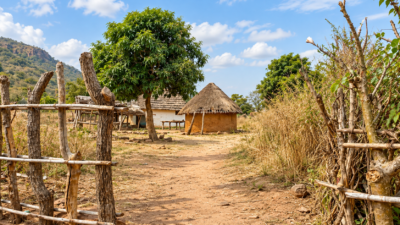
Nimo picked her up anyway. By the time he arrived at her residence, the sun was already rising. He came carrying a gallon of water on his shoulder. He found her wandering around the backyard and inspecting the bushes, already thinking of what changes she could make.
“Madam, you are already awake. Maakye.”
“Maakye,” she replied, walking toward him as he appeared from the narrow-paved path that led through the bush to her hut. He wore an oversized shirt and trousers that looked tighter than they could comfortably hold his legs. He poured the water into a worn metallic barrel inside a small outdoor kitchen built with bamboo and thatch, just beside her hut.
Shortly afterward, they headed to the palace. Once again, Nimo told her about a trip he had made to the city with his uncle when he was much younger. As they walked, she glanced briefly at the building closest to hers. It was silent. She had wanted to ask Nimo about her neighbour but decided against it. Sooner or later, she thought, they would get to know each other. There was no rush.
At the palace, they gave her roast plantain, three fingers of it. She took mouthfuls of water after each bite; she was not used to eating dry foods for breakfast. It had always been omelettes and tea, sometimes porridge. All the while, the chief’s wife was busy in the kitchen with her daughter strapped to her back. The child would wiggle and cry, and she would let her down to play, only to strap her back up when she became a distraction. The only thing she said to Asibi that morning was, “Did you sleep well?” To which Asibi replied, “Much better than I had expected.”
The way the woman smiled and returned to the kitchen made Asibi realize she was simply shy.
When she finished eating, the chief took her to the school. They walked through thick bushes, with the chief leading the way, machete in hand, cutting down weeds when necessary. By the time they arrived, her clothes were covered in thorns. She took her time removing them, as they pierced her skin and made her itch.
The chief had already gone ahead and was standing in one of the classrooms, looking around. He seemed surprised himself by how awful the place looked. Asibi was startled by the spider web that brushed her face when she stepped inside. She tried to wipe it away, but it felt like there was always a strand still on her skin.
The cement walls were peeling. What had once been a blackboard now looked almost white, the last chalk writings barely visible. The windows, made of plywood, looked so weak they might fall with a single poke. Dust coated everything. A few lizards scurried across the floor and disappeared into the ceiling.
Desks meant for two students had been stacked on top of each other. She brushed away fallen leaves on the floor, revealing broken cement with sharp stones jutting out dangerously.
They checked the other classrooms. Tree branches had grown into some. Weeds had overtaken others. The whole area was overgrown. There was no doubt that it posed a danger, especially from reptiles.
“What actually happened?” she asked.
“They built this school several years ago, during an election year. We had a dozen teachers from the city.”
“I see.”
“They built schools in Asotore, Abebu, Menteye, and other nearby towns too. But few survived after the elections. The teachers stopped receiving salaries, so they all left and returned to the city to find work.”
“Has any district education officer visited since the collapse?”
The chief scoffed. “Those people. They come once in a while, pretending to care; it is all part of their politics. The last time they came, I didn’t even bother following them around. They say the same things… ‘We will build teacher bungalows,’ ‘we will provide a well,’ ‘we will renovate the classrooms.’ Lies. All lies.”
“That is really unfortunate.”
“There was only one teacher who stayed. Sir Victor. But even he gave up. How could he run a school alone?”
“When did he leave, finally?”
“Leave? No, he didn’t leave. He is my son-in-law. He married one of my daughters.”
“Your in-law?”
“Yes.” The chief looked around and sighed. “There is a lot to do, but the community will be willing to help. Be patient. You just arrived. The other chiefs, farmers, and elders are yet to meet you. You will have the chance.”
Asibi appeared distracted, gazing into the abandoned room.
“I think we can go. I need to be at the maize farm with Nimo,” the chief said.
She followed. Then asked, “When did they marry?”
“A few years ago.”
“Mmm.”
“They have two daughters now.”
“And how old was your daughter then, Nana?”
The chief hesitated, then gave a nervous laugh. “You city people with your rules. Trust me, my daughter was old enough to carry a baby. That is all that matters. If she can give birth, who cares about her age?”
He chuckled alone. “She’s twenty now,” he added. Asibi only nodded.
They walked back in silence. Her mind churned with questions and anxieties. The school was worse than she had imagined. How was she going to succeed? Would the community take her seriously? Could she do this alone? Certainly not.
And yet, she tried to quiet the part of her mind that was confused about Sir Victor. She wanted to meet him, to learn from him. But more than that, she was curious — how had he ended up here, married to the chief’s daughter? How old was he? Why had he stayed after the school collapsed? What was he doing now? Would he be willing to help her?
She could almost hear Vivi whispering in her head: “Relax. Relax, overthinker.”
“I have to head to the farm now,” the chief said as they reached her hut. “But I asked a young girl to come take you around and show you a few places. She’ll pick you up soon. In the evening, we will meet with some of the elders.”
“Thank you, Chief.”
“If you need anything, ask my wife for now. She’ll bring your lunch around midday.”
“She doesn’t have to. I’ll come for it.”
“No, please. You are our guest. Just relax.”
He didn’t look like he would take no for an answer, so she agreed. Just before he left, she asked quickly,
“Would it be possible to see Sir Victor?”
“Oh yes. Don’t worry. I already told him about you. He cannot wait to meet you. He’ll be back from a trip next week. You’ll meet him soon.”
“That is good to hear,” she said, smiling.
“See you later, Madam.”
She returned to her hut and began making mental notes. She was scared and anxious, but one thing she still had was hope. And for now, she believed that was enough.